
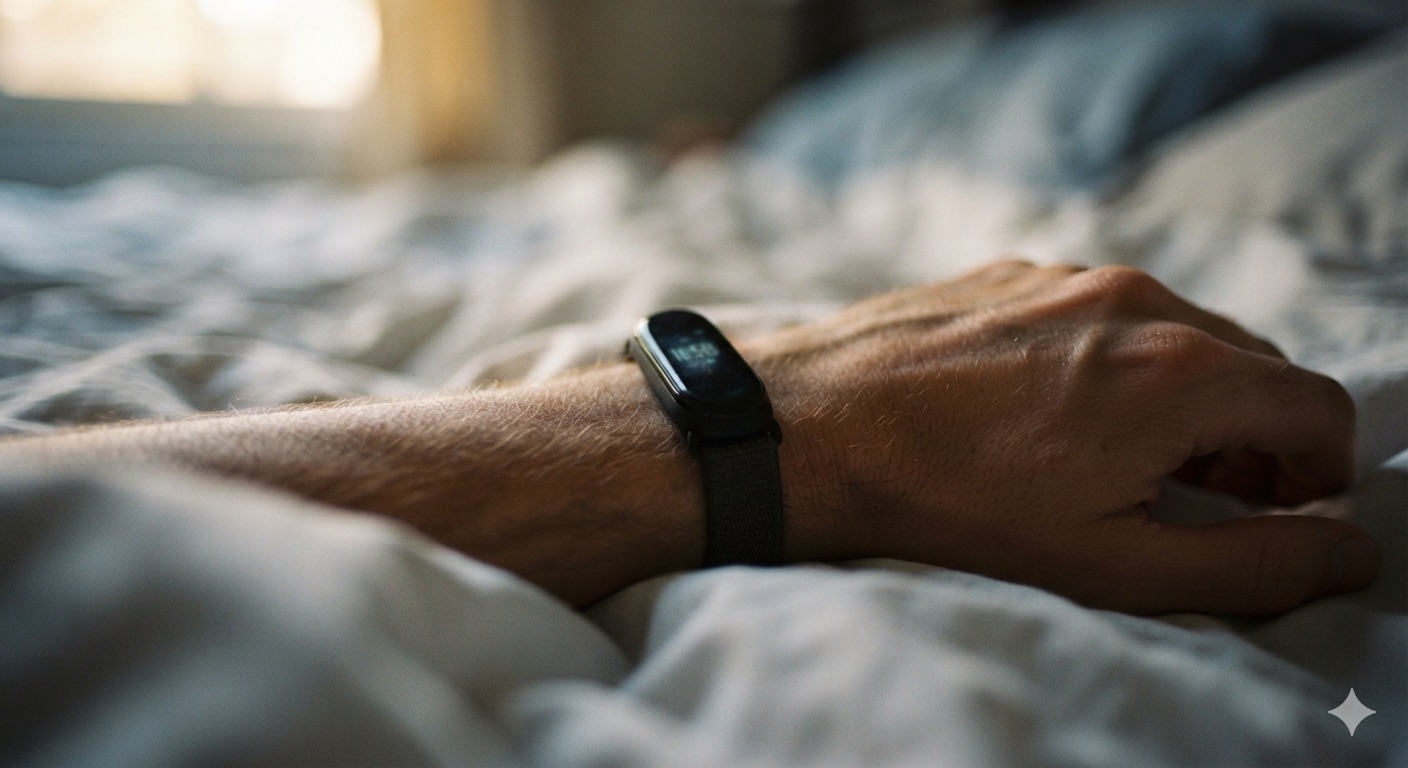
Your phone tells you that you slept badly. Recovery score in the red, deep sleep down, a little red exclamation mark suggesting you take it easy today. You feel fine. Genuinely fine — rested, clear-headed, ready for the day. So which one do you believe: the way you feel, or the number that says you shouldn’t feel that way?
This disagreement is becoming a daily occurrence for anyone wearing a ring, a watch, or a chest strap. It’s not a trivial question — it’s a live argument about where authority actually lives, in the body having the experience or in the device measuring it.
The Case for the Data
The tracker doesn’t get tired. It doesn’t rationalize a bad night into “not that bad, actually,” because it doesn’t have an ego invested in the outcome. Heart rate variability, resting heart rate trends, and respiratory rate can surface a pattern weeks before it turns into something you’d notice on your own. A slow drift toward overtraining, an oncoming illness, a stress load that hasn’t announced itself yet in any way you’d consciously register.
That gap between what you feel and what’s actually happening is well documented, and not because people are stupid. It’s because the body is remarkably good at normalizing a slow decline. You adapt to chronic under-recovery the same way you adapt to a room that smells bad the moment you stop noticing the smell. The data doesn’t adapt. It just reports.
There’s also the plain fact that subjective feeling is suggestible. Tell someone they slept poorly and they’ll often report feeling worse than someone who slept identically but wasn’t told anything. The data, whatever its flaws, isn’t trying to talk you into anything.
The Case for the Gut
Here’s what the data-first argument leaves out: the tracker has never been you. It’s built on population averages, sensor proxies, and an algorithm that treats “movement” as a stand-in for sleep depth and “heart rate variability” as a stand-in for readiness. Reasonable proxies, but proxies all the same. When the read on the screen doesn’t match your lived experience, that’s not automatically you being wrong. Sometimes it’s the device mismeasuring a body it was never calibrated to.
And there’s a deeper problem once a metric becomes something you optimize for. The moment a recovery score turns into a daily performance to chase, checking it stops being neutral information-gathering. It becomes its own source of anxiety, which is its own drag on actual recovery. A number designed to reduce stress can end up manufacturing it instead. The felt sense of “I’m fine” gets overruled by a screen telling you that you’re not allowed to be.
Medicine, for what it’s worth, has always started with the patient’s own report. “Where does it hurt” is the oldest diagnostic question there is, and it still comes before any instrument gets involved. Your gut has a track record too.
Both Signals Are Real
Neither side is arguing in bad faith. The data-first view is right that some things are genuinely invisible to feeling alone — a resting heart rate creeping upward for months is a real pattern, not a mood. It’s almost a mirror image of trusting a symptom checker over your own body: there, the external source is usually the less reliable one; here, it’s often the more reliable one. But the gut-first view is right that the feeling of being fine is not nothing. It’s information too. It’s the only source that actually knows what it’s like to be you today, in this body, doing this life.
The mistake is treating either one as the tiebreaker by default. A score that contradicts how you feel is worth a second look — not automatic obedience and not automatic dismissal. Check whether something explains the mismatch: a late night you’re underestimating, a stressful week the number caught before you consciously clocked it. If nothing explains it and you genuinely feel good, that’s data too. It just doesn’t come with a graph.
So when the two disagree, which do you interrogate first — the feeling, or the number claiming to know your body better than you do?

Leave a Reply